The Whole Plate
There is a common worry that keeps people from ever starting with AI: Everything changes every three months. Whatever I learn now will be obsolete by winter. Why board a moving train?
The worry is correct. Some of what you learn this week will be useless by winter, but that’s okay, because that’s not the point. The mistake isn’t learning something that won’t last. It’s assuming that’s all you’re doing.
New models, renamed products, redesigned apps, features appearing and disappearing. Tutorials go obsolete within a year.
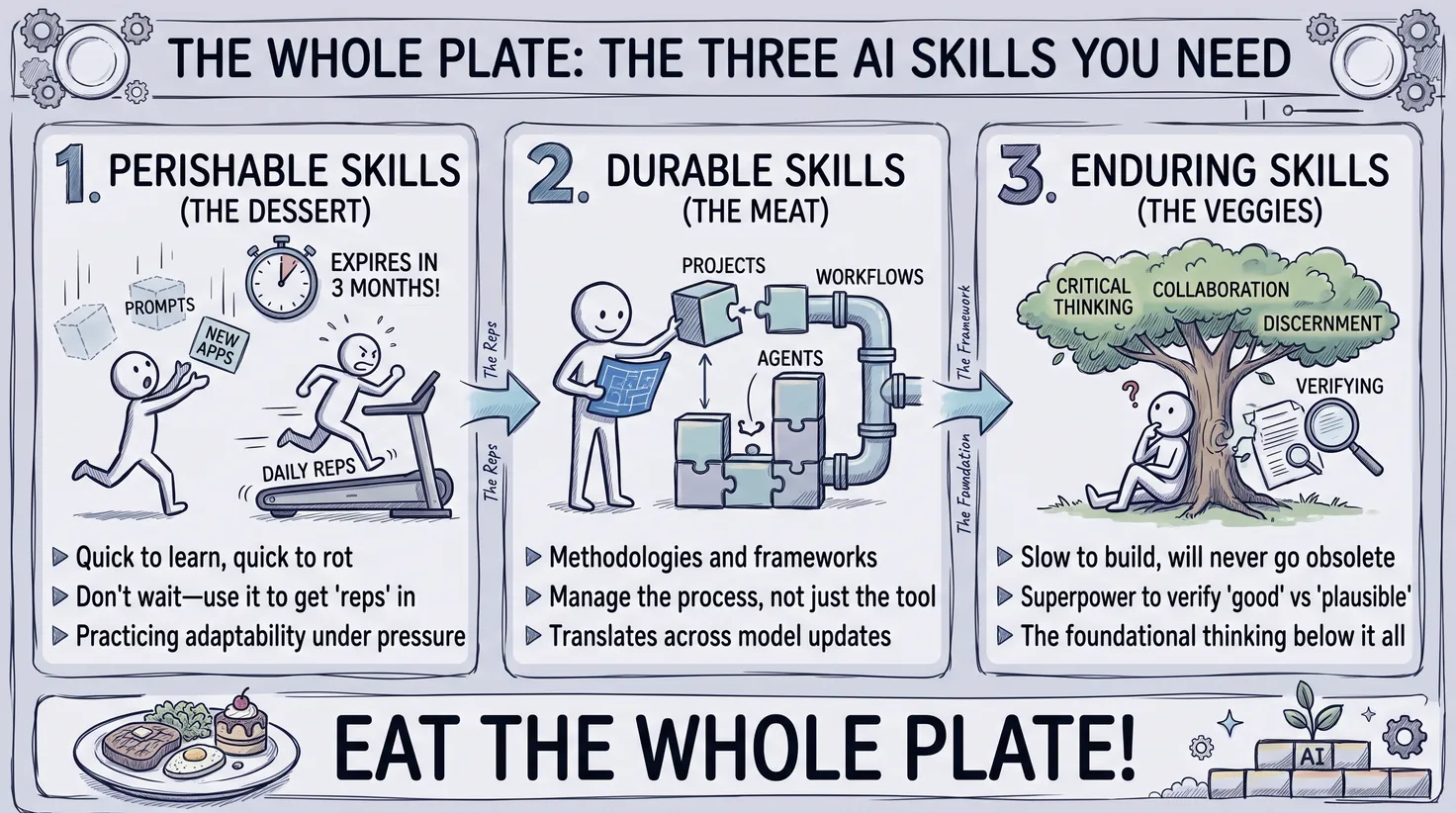
I’ve been thinking about this since recording an episode of 8minute.ai with Kathleen Walch from PMI. She built a framework around three types of skills for the AI era, based on how fast each one decays.
Perishable skills. Prompt engineering, context engineering, learning your way around whichever models shipped this week. Quick to learn, quick to rot.
Durable skills. Methodologies and frameworks. The step-by-step approaches for running and managing an AI project. If you’re building an agent, that’s a project, and projects need a method.
Enduring skills. Critical thinking, collaboration, communication, discernment. Slow to build, and they transfer to everything you will ever do.
Here’s how she puts it:
“I like to think about this as a plate analogy. If you go to a buffet, you want to make sure you have a balanced plate. If you focus on just those perishable skills, all the desserts, it’s going to be quick to learn but quick to decay. You’re not going to be satiated, and you’re going to want to come back for more constantly. You need to make sure you’re balancing your plate.”
You need all three. But perishable skills are the one everybody gets hung up on when starting, since it’s the one that rots fastest: why learn something you’ll relearn in a month anyway?
I’m guilty of it too, filing perishable skills under necessary overhead: something to get through so you could move on. The new model, the new buzzword. But it occurred to me: the skill itself is disposable, but what you build while acquiring it isn’t. You practice running into something unfamiliar and getting oriented under time pressure. That’s what teaches adaptability.
And in this AI era, adaptability matters more than it ever has.
Waiting for the dust to settle made sense for every previous wave of technology. Here it’s quietly turned into never starting at all. What you lose by waiting isn’t a feature or a head start, it’s the reps.
The train isn’t something you missed. Some of what you learn this week will be gone by next season, and that was never the part to keep.
Learn the model that’s here right now, not despite the fact it’ll be replaced, but because replacing it is what gets you the reps. Build a way of running the work. And keep the slow layer running underneath both the whole time: the thinking, the verifying, telling a good answer from a plausible one.
Perishable, durable, enduring. Eat the whole plate. The dessert is what forces you to get your reps in.