You Don't Need a Project
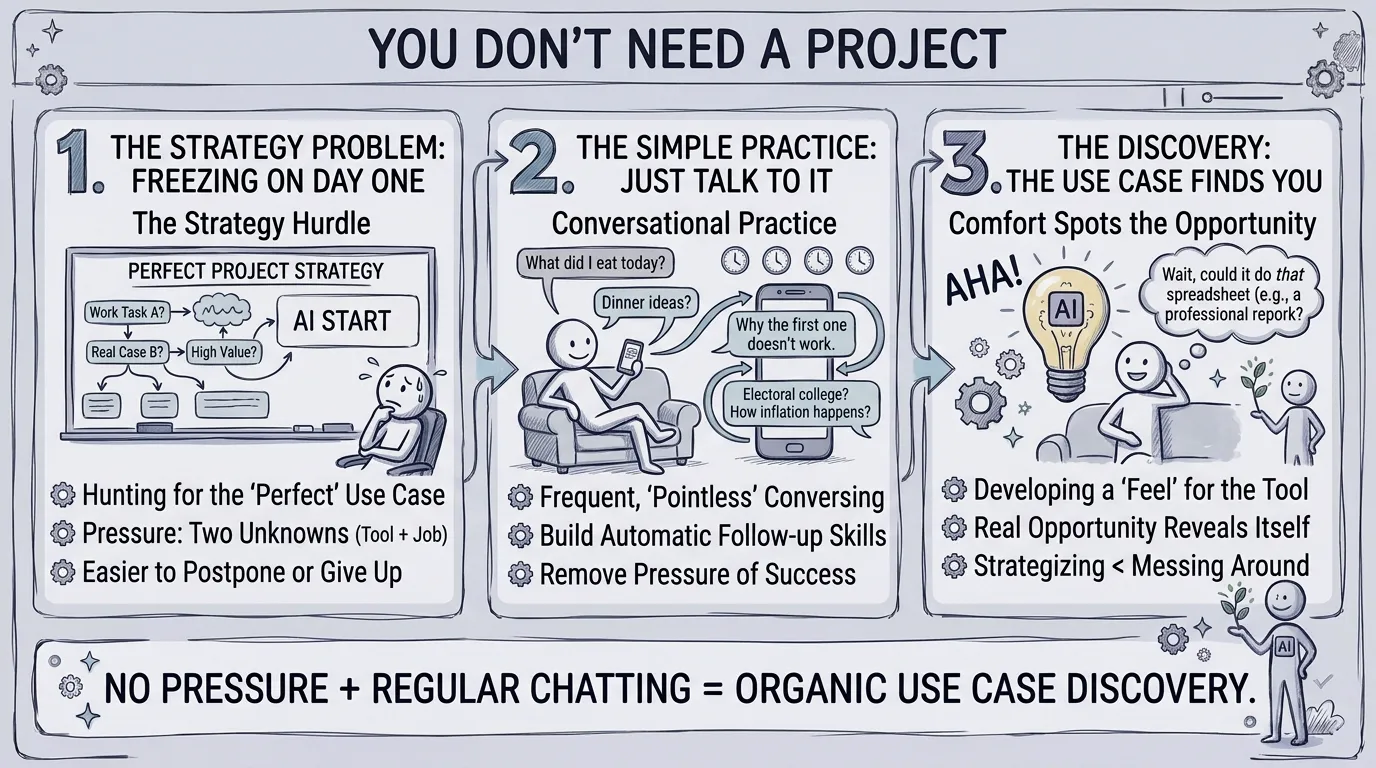
I often hear beginners told to find a use case first. Pick a real task from your work and let AI help you with it.
I disagree with that. For a lot of people, that’s a big hurdle and a reason for giving up before they even start.
Look at what it asks of someone on day one. Learn a tool you’ve never used, and pick the right job for a tool you don’t understand yet. Two unknowns, and the second depends on the first.
So you hunt for the perfect task, and get your first impression from a guess you have no basis for making. What if you picked a bad use-case? What if you prompt it wrong? Easier to put it off another week.
Here’s the alternative: you don’t need a project. You’re allowed to just talk to it.
Tell it what you ate today. No question attached, just the list, and see what it does with that.
Ask for a dinner idea, then say why the first one doesn’t work. Too much effort for a Tuesday. You don’t have half those ingredients. You had pasta last night. Watch it adjust. Tell it what’s actually in your fridge and make it work with that instead.
Tell it about a movie you liked and ask what else you’d like. Then argue with the list. Say what specifically you liked, not just that you liked it, and see how much better the second list comes back.
And when something comes up that you only half understand, ask about that too. The electoral college. How inflation happens. The lingo your kid keeps using.
None of this is productive. It isn’t supposed to be.
What it’s buying you is what beginners actually need: how it answers, how it phrases things, where it’s genuinely useful and where it’s too vague. What a good response looks like is not something you can read your way to. You learn it by seeing a few hundred and noticing the differences.
Notice that most of those examples have a follow-up built into them. Ask, read what came back, and tell it what’s wrong with it. Doing that while the topic is dinner is what makes it automatic later, on the things that matter.
The pressure is the part you’re removing. No assignment means no wrong answer. If it’s useless you shrug and type something else.
The only rule I’d add is to do it more than once. A few minutes most days, whenever it fits. Come home from work, open a chat, talk about your day. It doesn’t need to be scheduled and it doesn’t need to go anywhere.
The most useful learning happens when you’re messing around. Not when you’re trying.
And somewhere after a week or two of pointless chatting, mid-conversation about dinner or last night’s movie, you’ll think: wait, could it do that thing from work?
That’s the use case everyone told you to hunt for. It finds you, once you have enough of a feel for the tool to spot it. Use cases reveal themselves to people who are already comfortable. They hide from people staring at a blank chat window trying to be strategic.
So if “pick a task” has you frozen, skip it. Open a chat and talk about something that doesn’t matter at all.